

The Hidden Cost of Waste Management: Is Your Business Paying a “Bin Tax”?
For most Australian manufacturing, logistics, and retail businesses, waste management is treated as an inevitable, fixed utility bill. Skips turn up, loose cardboard and plastic are tossed inside, trucks haul it away, and an invoice is processed.
But if you look closely at the operational layout of your facility, your current waste setup is far from fixed. In fact, it is likely acting as a hidden drain on your three most valuable resources: Time, Space, and Money. If your facility relies entirely on traditional loose wheelie bins and massive external skips, you aren’t just paying for disposal. You are paying a hidden “Bin Tax.”
On this page, we uncover three hidden “waste taxes” that quietly inflate operating costs and show you how to calculate the true cost of your waste infrastructure - and engineer it out of your business overheads.
1. The Financial Tax: Paying to Haul Air
When you look at a traditional 1100L skip filled with loose cardboard boxes or plastic film, what are you actually looking at? Visually, it looks full. Operationally, you are paying to transport approximately 90% air and 10% material.
Commercial waste collection companies charge you by the lift or by volume. When your team throws uncompacted waste into an external skip, the physical footprint expands instantly. You reach your volume thresholds long before you reach weight capacity.
Furthermore, state-based environmental policies are aggressively penalising loose waste disposal.
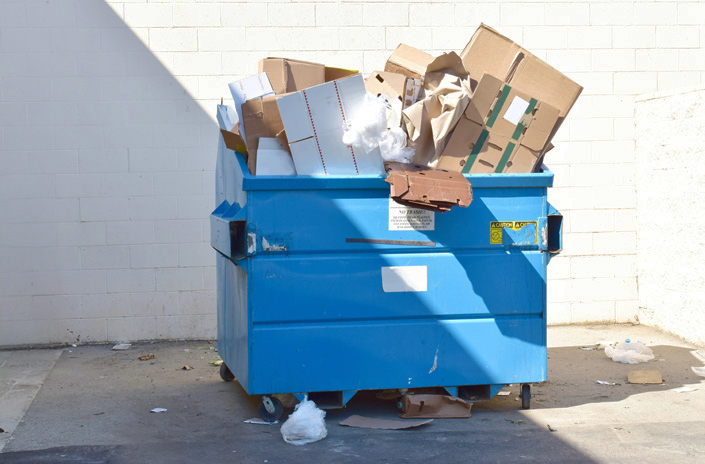
For instance, with the NSW Landfill Levy sitting at $180.30 per tonne, letting recyclable material slip into general waste streams is an immediate financial penalty. By compressing that waste at the point of source into highly dense bales, you invert the financial model: you slash collection frequencies by up to 80% and convert a disposal cost into a continuous recycling rebate.
2. The Labor Tax: The "Walking Bottleneck"
The cost of waste isn't just calculated on the collection invoice; it's tracked on your payroll. Consider the physical journey of a warehouse operator or shop floor worker:
They unpack a pallet or a shipment.
They flatten a bulky cardboard box manually.
They walk out of the primary operational area, down a corridor, through a security door, and to an external skip. They throw the box away and walk back.
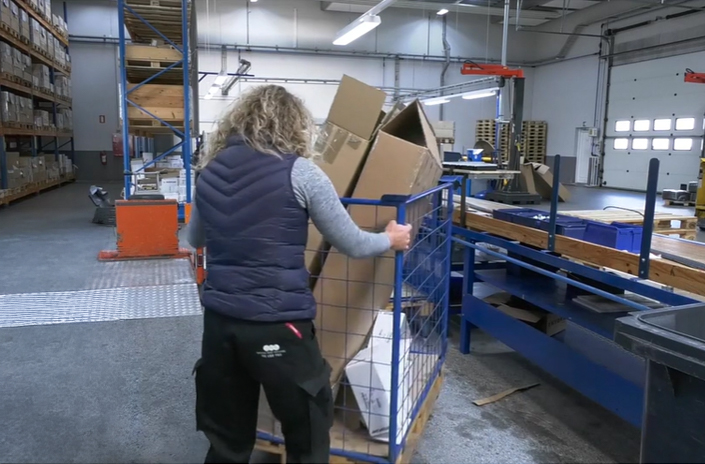
If transporting waste takes three minutes and happens twenty times a day across a team of ten workers, your facility is losing 10 hours of productive labour every single week to foot traffic alone.
At an average Australian wage rate of $35 per hour, that walking bottleneck can represent a silent payroll leak worth thousands of dollars every year. Waste handling is a non-value-adding activity, yet many businesses unknowingly dedicate valuable labour hours to moving waste rather than driving productivity.
Australia-Wide Operational Proof: By optimising point-of-source compaction, Mil-tek has helped Australian businesses recover more than 66,480 productive labour hours, transforming wasted transit time into measurable operational output..
3. The Spatial Tax: Squandering Your Real Estate Footprint
Industrial warehouse space in Australia is at an all-time premium. Every square meter of your facility must be optimized for production, assembly, or revenue-generating inventory storage.
Yet, traditional waste systems demand a massive spatial footprint. Staging areas filled with rows of 1100L wheelie bins or large, open skips eat up valuable warehouse floor space. Worse, loose stockpiles of overflowing packaging create immediate Workplace Health & Safety (WHS) hazards, restricting exit paths and increasing fire risks.
Replacing a cluster of loose bins with a single pneumatic or electric baler reduces your waste storage footprint by up to 80%. This immediately reclaims square meters of high-value indoor real estate that can be instantly reallocated to racking, inventory, or machinery.
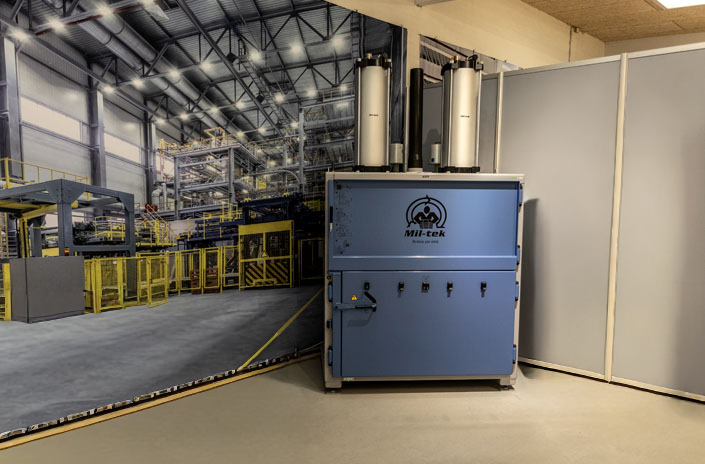
In many Australian facilities, waste storage areas quietly occupy some of the most expensive square meters in the building. Rows of wheelie bins, overflowing cardboard cages and temporary waste stockpiles often consume valuable operational space while simultaneously creating Workplace Health & Safety (WHS) risks.
By reducing waste volume by up to 90%, point-of-source compaction can dramatically shrink the footprint required for waste handling. Businesses can then repurpose that reclaimed space for additional inventory, production capacity, racking systems or revenue-generating operations.
Operational Reality: Every square meter dedicated to storing air-filled waste is a square meter that cannot be used to grow your business.